
Legal AI Without Institutional Memory Is Just Expensive Autocomplete
The legal industry is entering a dangerous phase of AI adoption.
Many organizations now believe they have “implemented Legal AI” because they added a chatbot, connected a document repository, or deployed a large language model inside Microsoft 365.
But most of these systems suffer from the same fundamental flaw:
They do not understand the institution.
Without institutional memory, Legal AI becomes little more than sophisticated autocomplete — fluent, impressive, and operationally shallow.
The future of legal intelligence will not belong to organizations with the most AI tools.
It will belong to organizations that successfully operationalize their accumulated legal knowledge.
That distinction matters enormously.
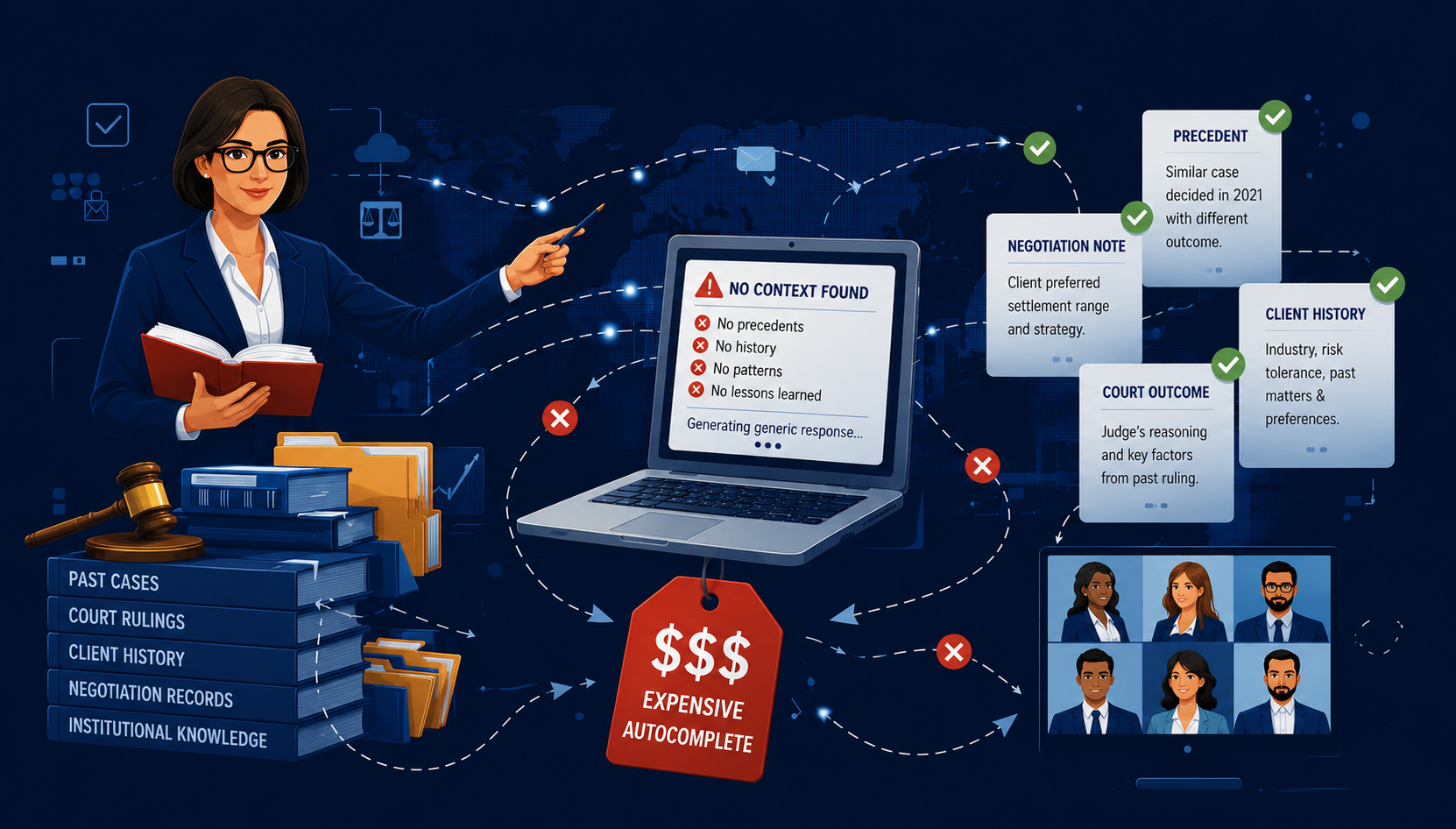
The Hidden Problem With Most Legal AI Systems
Most AI deployments in legal environments operate transactionally.
A user asks a question.
The system retrieves a few documents.
The model generates a response.
This appears intelligent on the surface.
But what the system usually lacks is organizational continuity:
- Why was a clause negotiated differently three years ago?
- Which risk positions were historically rejected by the firm?
- What guidance became institutional policy after litigation?
- Which counterparties repeatedly triggered escalations?
- Which deviations ultimately caused downstream disputes?
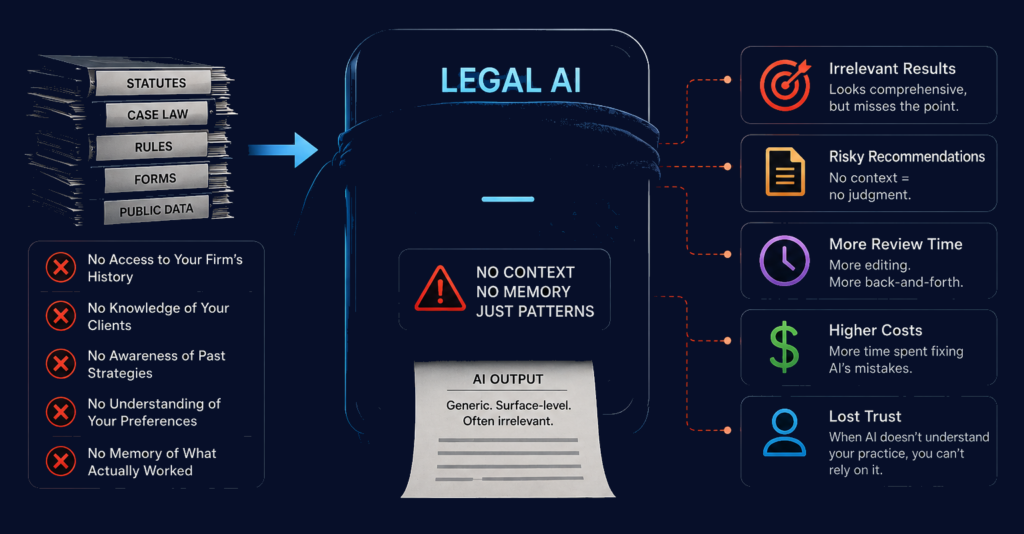
Traditional AI systems rarely know.
Because most legal organizations have spent decades storing documents — not preserving institutional reasoning.
This creates an enormous gap between:
- Information retrieval
and - Institutional intelligence.
What Is Institutional Memory in Legal AI?
Legal knowledge is often misunderstood as document storage.
But institutional memory institutional memory is not merely a collection of files, contracts, or emails.
Institutional memory is the accumulated reasoning of the organization:
- why decisions were made,
- how risks were evaluated,
- which negotiation positions were accepted or rejected,
- what operational patterns emerged over time,
- and how the organization evolved legally and commercially.
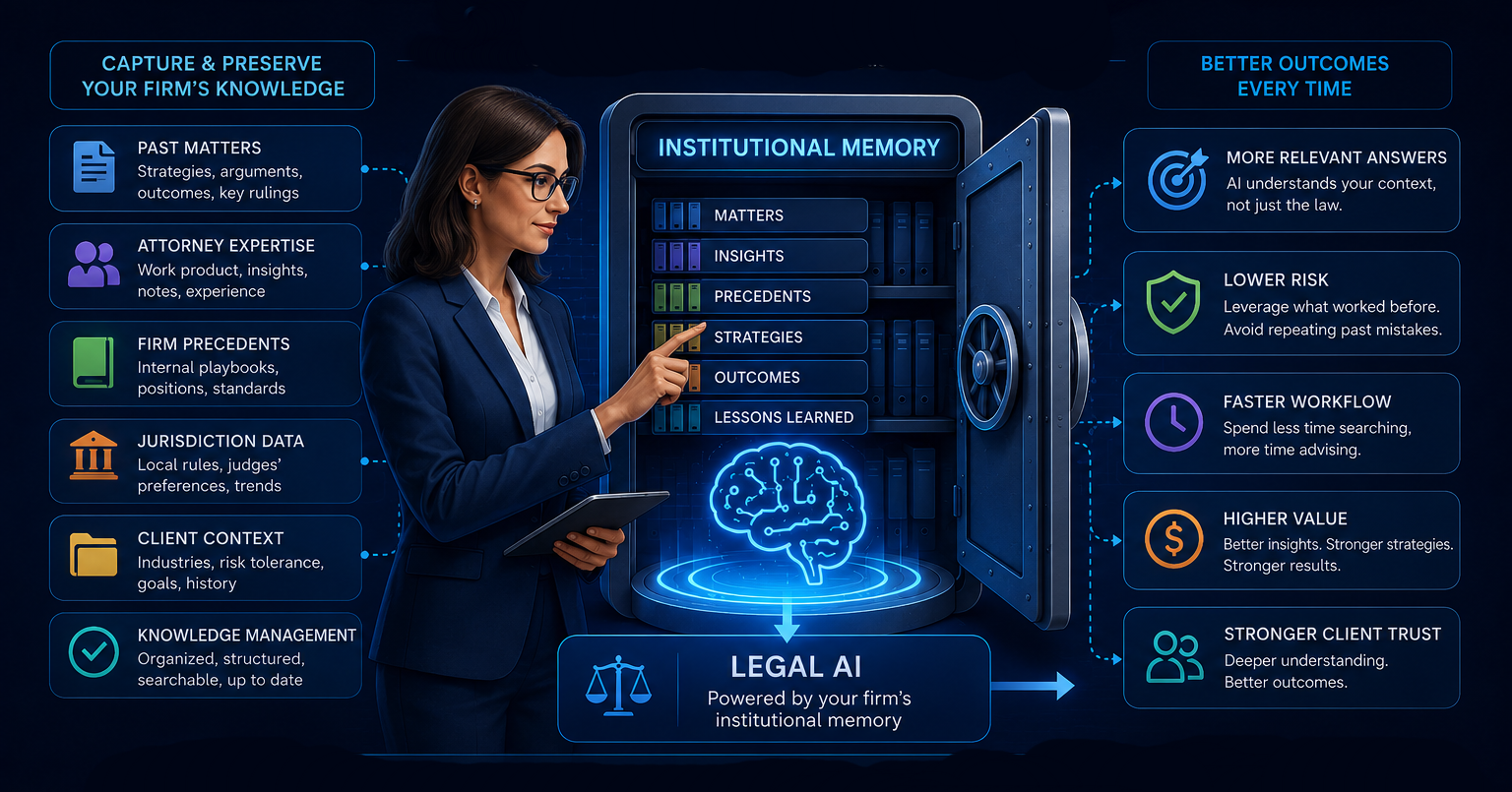
Every legal department and law firm already possesses an enormous proprietary dataset:
- negotiated contracts,
- regulatory interpretations,
- litigation outcomes,
- approval patterns,
- exception handling,
- risk tolerance evolution,
- internal advisory memos,
- and operational precedent.
This is not merely content.
It is institutional intelligence.
The organizations that treat legal work product as reusable intelligence will compound advantage over time.
The organizations that do not will continuously “relearn” what they already know.
That inefficiency becomes catastrophic at enterprise scale.
Why Generic AI Fails in Legal Environments
Generic AI systems are optimized for language generation.
Legal organizations require:
- governance,
- traceability,
- contextual reasoning,
- precedent continuity,
- permission-aware access,
- and defensible outputs.
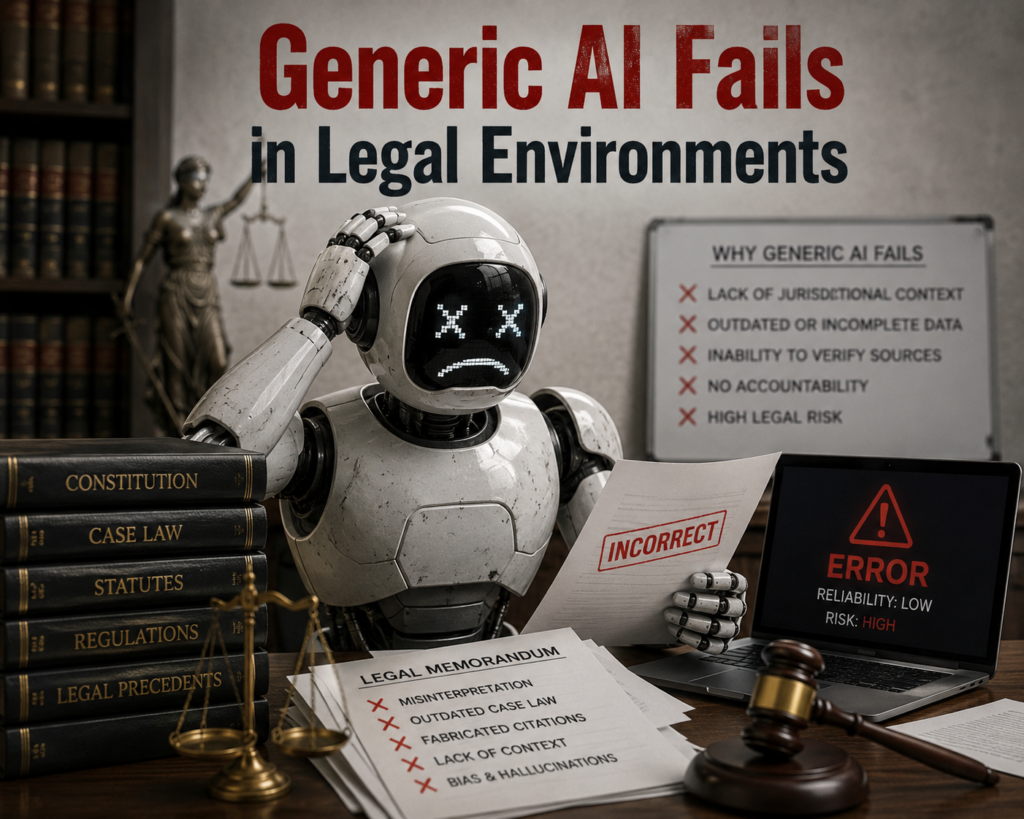
A legal AI system that produces a convincing answer without grounding in institutional precedent introduces operational risk.
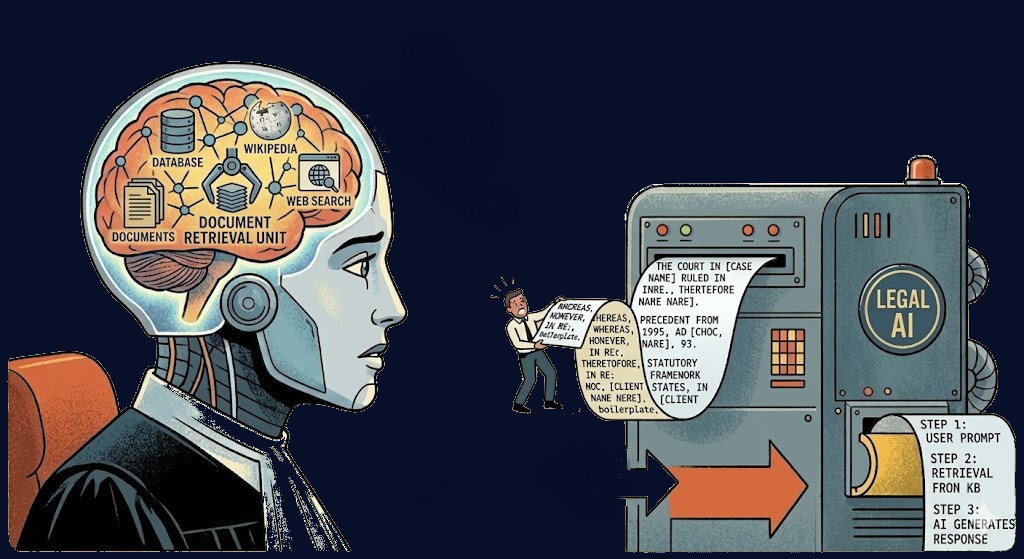
In legal operations, hallucination is not merely a technical flaw.
It is a governance problem.
This is why retrieval alone is insufficient.
Even systems using RAG (Retrieval-Augmented Generation) often operate as:
- document fetchers,
- semantic search engines,
- or conversational interfaces layered over fragmented repositories.
But institutional intelligence requires more than retrieval.
It requires:
- matter awareness,
- counterparty awareness,
- historical pattern recognition,
- and organizational context.
Why RAG Alone Fails for Legal AI
RAG has become one of the most widely discussed architectures in enterprise AI.
In theory, Retrieval-Augmented Generation improves model accuracy by grounding responses in organizational documents.
But in legal environments, retrieval alone does not create intelligence.
Most RAG systems answer questions by retrieving text fragments from documents and passing them into a language model context window.
That approach helps with:
- search,
- summarization,
- and document-aware responses.
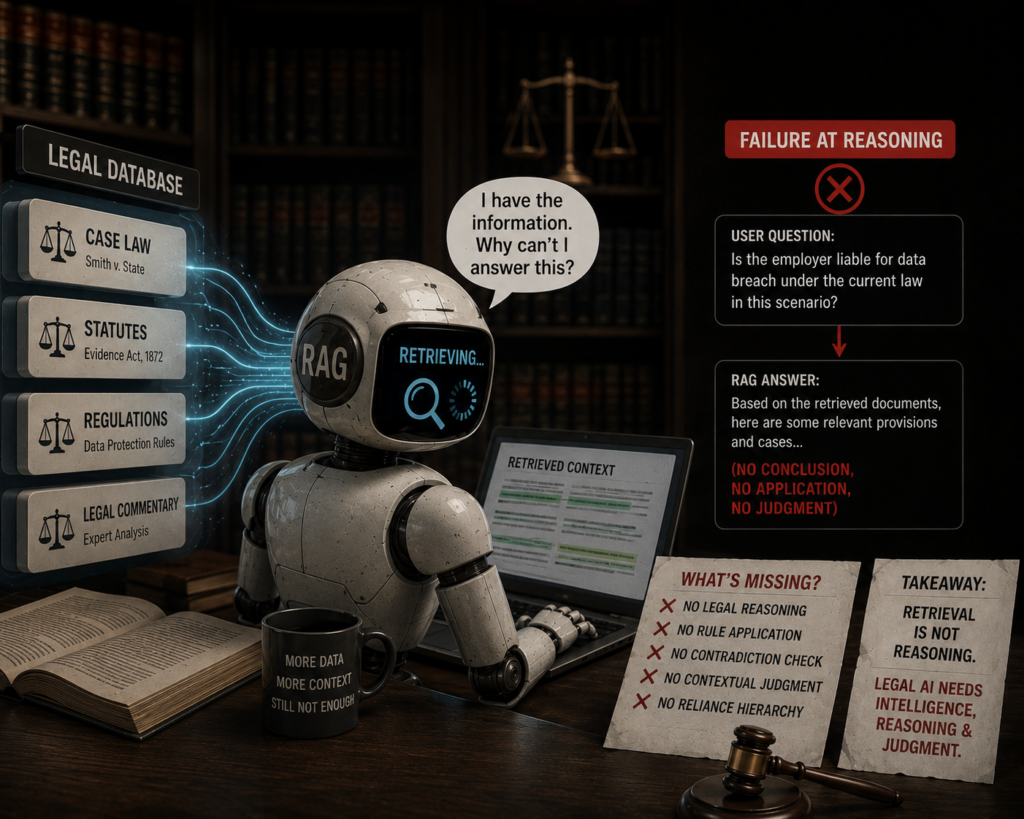
But legal organizations require significantly deeper reasoning.
A legal AI platform must understand:
- historical negotiation patterns,
- organizational risk tolerance,
- approval hierarchies,
- matter relationships,
- clause lineage,
- and institutional precedent continuity.
A system that simply retrieves similar clauses without understanding why those clauses evolved over time cannot reliably support enterprise legal decision-making.
This is where many Legal AI deployments fail.
They optimize for semantic retrieval while ignoring organizational cognition.
The result is an AI system that sounds intelligent but lacks institutional awareness.
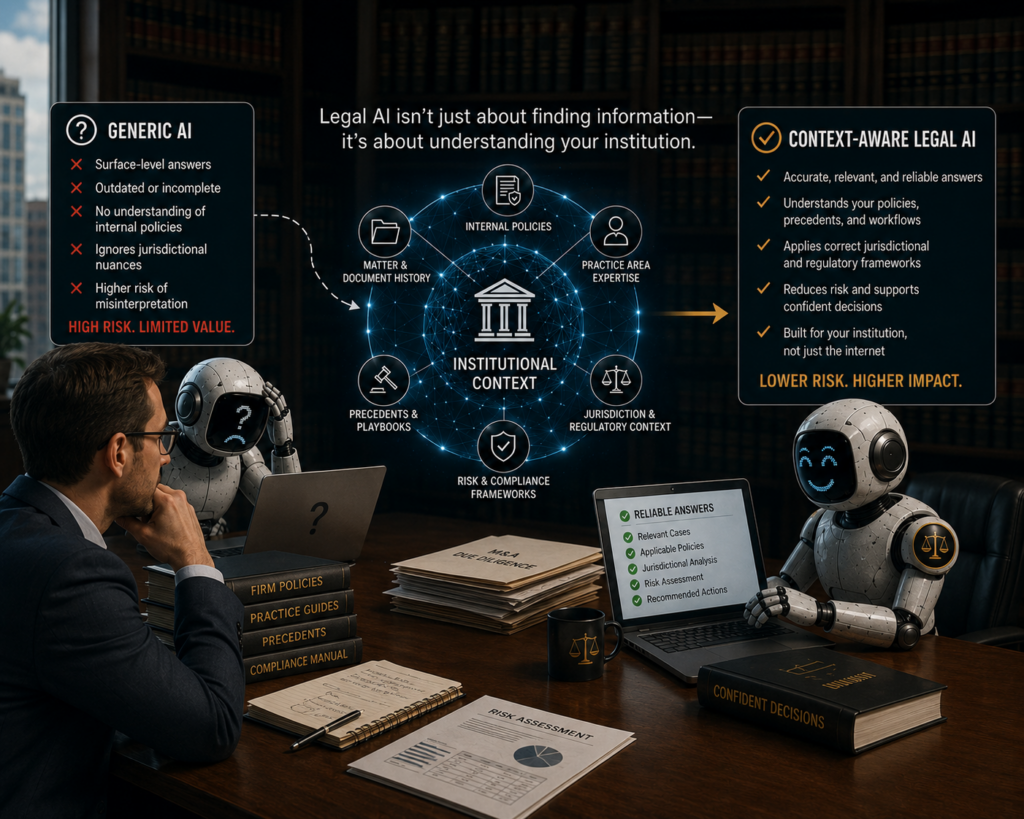
Enterprise Legal AI Requires Institutional Context
Enterprise legal AI is fundamentally different from consumer AI tools or generic productivity assistants.
Large legal organizations operate across thousands of contracts, matters, regulatory obligations, outside counsel relationships, and internal approval workflows. In that environment, AI cannot function effectively as a standalone chatbot layered over disconnected repositories.
Enterprise legal AI must operate with:
- institutional awareness,
- governance enforcement,
- contextual continuity,
- permission-aware access,
- and integration into existing operational systems.
This is especially important for global enterprises where legal decisions are distributed across business units, jurisdictions, and compliance frameworks. A system that merely generates fluent responses without understanding organizational precedent introduces operational inconsistency and legal risk.
The future of enterprise legal AI will therefore depend less on generalized language generation and more on institutional reasoning built directly into enterprise knowledge infrastructure.
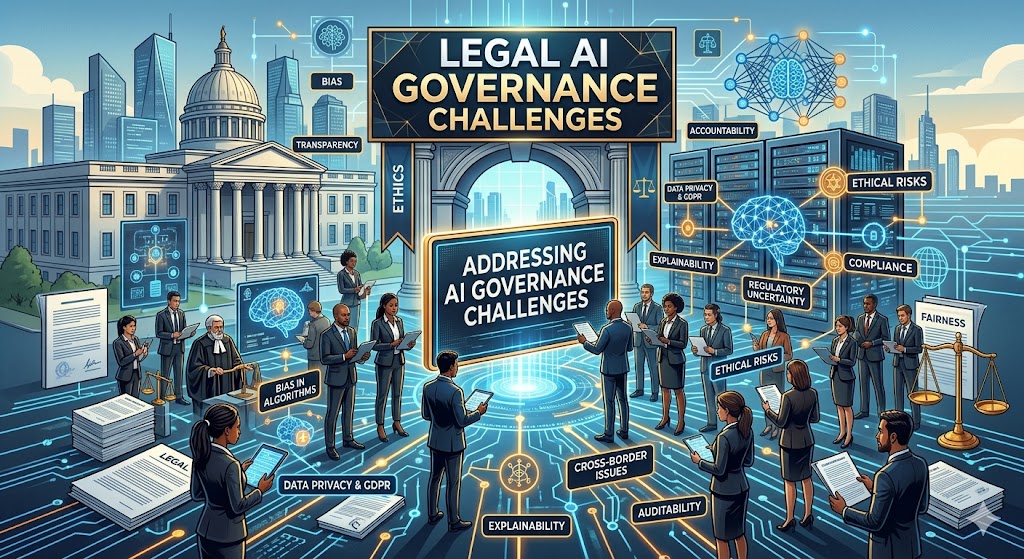
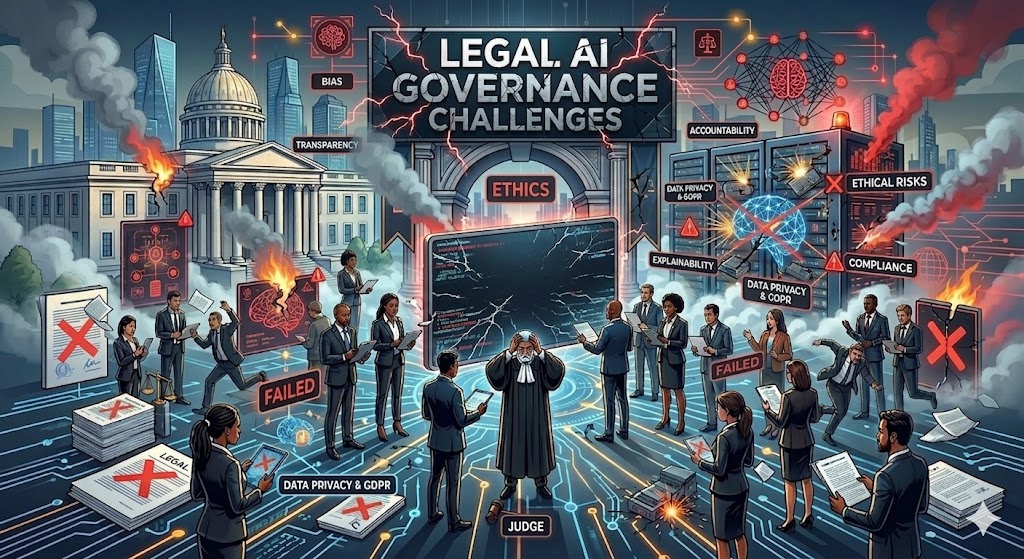
Legal AI Governance Challenges
Governance is becoming the defining issue in enterprise Legal AI adoption.
Legal organizations are not merely asking:
“Can the AI generate answers?”
They are asking:
- Can the outputs be trusted?
- Can decisions be traced?
- Can access controls be enforced?
- Can sensitive legal history remain protected?
- Can the system operate within regulatory and client confidentiality boundaries?
These are governance requirements, not user interface features.
Many AI architectures create governance problems because they:
- export enterprise data externally,
- replicate documents into secondary environments,
- bypass native permissions,
- or create opaque reasoning chains.
This creates operational and regulatory exposure.
In legal environments, AI systems must align with:
- zero-trust principles,
- delegated permissions,
- tenant-native security,
- auditability,
- and defensible information governance.
Without those controls, Legal AI adoption eventually encounters organizational resistance from legal leadership, compliance teams, cybersecurity groups, and clients themselves.


Secure Legal AI Is Becoming a Strategic Requirement
As AI adoption accelerates, legal AI governance is rapidly becoming the primary concern for enterprise legal leadership.
Organizations are no longer evaluating AI solely on speed or usability. They are evaluating:
- how legal outputs are generated,
- whether reasoning can be traced,
- how permissions are enforced,
- where enterprise data is processed,
- and whether the system aligns with internal governance policies.
This is why secure legal AI architecture matters enormously.
Legal departments increasingly require AI systems that operate within existing security boundaries rather than exporting sensitive legal content into external environments. For many organizations, this means prioritizing tenant-native platforms, delegated identity models, auditability, and zero-trust enforcement.
This requirement is particularly important for AI for in-house legal teams, where confidentiality, regulatory exposure, and operational accountability are central to daily legal operations.
As a result,legal AI for SharePoint and Microsoft 365-native environments is gaining strategic importance because these ecosystems already contain much of the organization’s institutional legal memory, security controls, and permission structures.
The long-term winners in Legal AI will likely be platforms that combine:
- institutional memory,
- secure enterprise architecture,
- governance-aware AI execution,
- and contextual legal intelligence within existing enterprise systems.

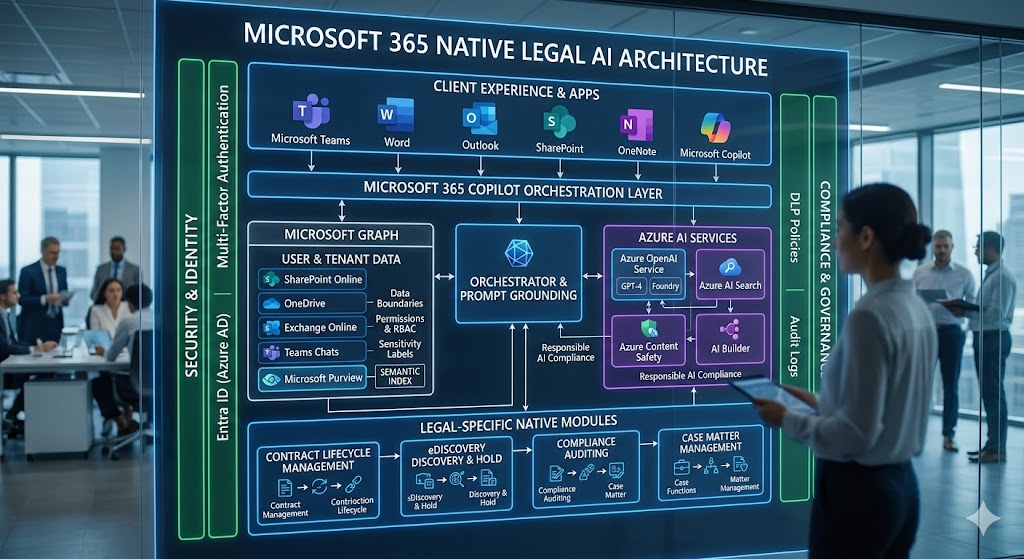
Microsoft 365 Native Legal AI Architecture
Architecture matters enormously in Legal AI.
Most AI vendors still rely on external synchronization models:
- exporting documents,
- building shadow indices,
- replicating data externally,
- or bypassing native permission structures.
This creates security, governance, and trust problems.
Modern legal organizations increasingly require:
- data sovereignty,
- zero-trust enforcement,
- tenant-native deployment,
- and permission inheritance.
This is strategically important because institutional memory only becomes valuable if organizations trust the infrastructure enough to expose their real legal history to the system.
Without trust, institutional knowledge remains fragmented and inaccessible.
The architecture described by Arivu.Legal reflects this enterprise shift toward Microsoft 365-native legal intelligence. Rather than externalizing legal repositories, the platform emphasizes in-tenant reasoning, delegated permissions, and contextual intelligence operating directly within the Microsoft ecosystem.
Arivu’s “Resident Agent” model is especially notable because it positions AI not as an external overlay, but as a governed intelligence layer operating within the organization’s existing legal knowledge boundary.
That distinction becomes critical as enterprises move from experimental AI deployments toward operational legal intelligence systems.


Why Legal Knowledge Management Is Evolving
For decades, legal knowledge management focused primarily on storage:
- document repositories,
- folder structures,
- metadata,
- precedent libraries,
- and enterprise search systems.
But search is not intelligence.
Traditional legal KM systems were designed to help professionals locate information manually.
It is becoming cognitive infrastructure:
systems capable of understanding how institutional decisions evolve over time.
- matter-centric indexing,
- contextual inference,
- clause lineage tracking,
- organizational reasoning,
- and governed AI execution.
In other words:
The AI system must understand the enterprise as a living legal organism.
The shift is profound.
Legal departments are no longer simply managing documents.
They are beginning to operationalize institutional intelligence itself.


AI for In-House Legal Teams Is Moving Beyond Productivity
The first wave of Legal AI focused heavily on productivity:
- drafting faster,
- summarizing documents,
- generating responses,
- and accelerating research workflows.
But in-house legal teams increasingly require something much more strategic.
Modern corporate legal departments operate as enterprise risk management functions deeply connected to procurement, compliance, finance, HR, cybersecurity, and executive leadership.
In this environment, AI cannot merely generate language.
It must support institutional decision-making.
AI for in-house legal teams must therefore understand:
- prior legal positions,
- historical negotiation outcomes,
- business-specific risk tolerance,
- recurring counterparty behavior,
- regulatory guidance evolution,
- and operational precedent.
This is why institutional memory becomes central to enterprise Legal AI architecture.
Without organizational continuity, AI systems may produce technically plausible answers while ignoring years of accumulated legal and operational knowledge.
For enterprise legal departments, that creates both governance risk and strategic inefficiency.


Why Legal AI for SharePoint Is Gaining Momentum
For many enterprises, SharePoint already functions as the operational backbone of legal knowledge management.
Contracts, matters, emails, approval workflows, policies, playbooks, and advisory documents often already reside within Microsoft 365 environments.
As a result, legal AI for SharePoint is becoming increasingly important because organizations want AI systems that operate natively within existing enterprise infrastructure rather than forcing legal teams into disconnected external platforms.
This architectural approach offers several advantages:
- native permission inheritance,
- reduced data duplication,
- centralized governance,
- Microsoft security alignment,
- and preservation of organizational context.
More importantly, SharePoint environments often contain years of institutional legal memory that generic AI systems cannot access effectively when data is fragmented across disconnected repositories.
The future of enterprise Legal AI may therefore depend heavily on systems capable of transforming Microsoft 365 environments from passive document storage platforms into active institutional intelligence systems.
The Real Competitive Advantage in Legal AI
The market currently overvalues model sophistication.
But foundation models will commoditize.
What will not commoditize is institutional memory.
Every organization possesses:
- unique negotiations,
- unique risk histories,
- unique regulatory interpretations,
- unique advisory patterns,
- and unique operational precedent.
That corpus becomes the true moat.
The organizations that successfully structure and operationalize this memory will develop compounding intelligence advantages that generic AI systems cannot replicate.
Over time, the competitive advantage will not come from having AI.
It will come from having AI that remembers.


The Future of Legal Organizations
The next generation of legal organizations will not operate as collections of isolated professionals producing disconnected work product.
They will function as continuously learning institutional systems.
Every contract.
Every negotiation.
Every dispute.
Every approval.
Every escalation.
All becoming part of a continuously evolving organizational intelligence layer.
That transformation changes legal departments from cost centers of isolated expertise into strategic intelligence systems embedded directly into enterprise decision-making.
And in that future, the distinction becomes clear:
Legal AI without institutional memory is not intelligence.
It is merely expensive autocomplete.
Frequently Asked Questions
What is institutional memory in legal AI?
Institutional memory in legal AI refers to the accumulated legal knowledge, decision history, negotiation patterns, regulatory interpretations, and operational precedent developed by an organization over time. Instead of simply retrieving documents, institutional-memory-driven AI systems understand how and why decisions were historically made.
Why is institutional memory important for legal AI?
Without institutional memory, legal AI systems operate like advanced autocomplete tools that generate responses without understanding organizational context. Institutional memory enables AI to:
- recognize historical risk positions,
- identify negotiation patterns,
- maintain precedent continuity,
- support governance requirements,
- and provide context-aware legal reasoning.
This transforms legal AI from document retrieval into organizational intelligence.
Why do generic AI systems fail in legal environments?
Generic AI systems are optimized for language generation, not legal governance. Legal organizations require:
- traceability,
- defensible outputs,
- permission-aware access,
- contextual reasoning,
- and institutional consistency.
A convincing answer without grounding in organizational precedent can introduce operational, regulatory, and compliance risk.
What is the difference between legal AI and institutional legal intelligence?
Traditional legal AI often focuses on:
- chat interfaces,
- semantic search,
- and document summarization.
Institutional legal intelligence goes further by incorporating:
- historical legal decisions,
- matter context,
- counterparty behavior,
- organizational policies,
- and evolving risk tolerance.
This enables AI systems to reason using institutional context rather than isolated documents.
What is RAG in legal AI?
RAG (Retrieval-Augmented Generation) is an AI architecture where a language model retrieves relevant documents before generating a response. In legal environments, RAG improves factual grounding compared to standalone AI models.
However, retrieval alone is not sufficient for enterprise legal intelligence because it often lacks:
- organizational reasoning,
- matter continuity,
- clause lineage,
- and institutional context.
Why is governance critical for legal AI?
Legal AI systems influence contracts, regulatory interpretation, approvals, and risk analysis. Without governance, AI-generated outputs may:
- conflict with organizational policy,
- expose confidential information,
- bypass permission controls,
- or produce non-defensible recommendations.
Governed legal AI requires:
- auditability,
- native security controls,
- permission inheritance,
- and policy-aware reasoning.
What is tenant-native legal AI architecture?
Tenant-native legal AI operates directly within an organization’s existing cloud environment — such as Microsoft 365 — without exporting legal data into external systems.
This architecture improves:
- security,
- compliance,
- governance,
- and trust.
It also allows AI systems to preserve organizational context directly from systems like SharePoint and Teams.
Why does SharePoint matter for legal AI?
Many enterprise legal departments already store years of legal work product inside Microsoft SharePoint. This includes:
- contracts,
- negotiations,
- advisory memos,
- approvals,
- and operational records.
When AI systems can reason directly within SharePoint using native permissions and indexing, institutional knowledge becomes operationally accessible without duplicating or externalizing sensitive data.
What is contextual reasoning in legal AI?
Contextual reasoning is the ability of an AI system to evaluate information using organizational, historical, and operational context.
For example, instead of only identifying a clause, a context-aware legal AI system may determine:
- whether the clause deviates from organizational standards,
- whether similar language caused disputes previously,
- or whether a counterparty has historically negotiated similar positions.
What is the future of enterprise legal AI?
The future of enterprise legal AI is shifting from isolated AI assistants toward continuously learning institutional systems.
Leading legal organizations are moving toward:
- institutional intelligence layers,
- matter-centric knowledge architectures,
- governed AI reasoning,
- and enterprise-wide legal memory systems.
Over time, the competitive advantage will come not from simply deploying AI, but from operationalizing institutional legal knowledge at scale.